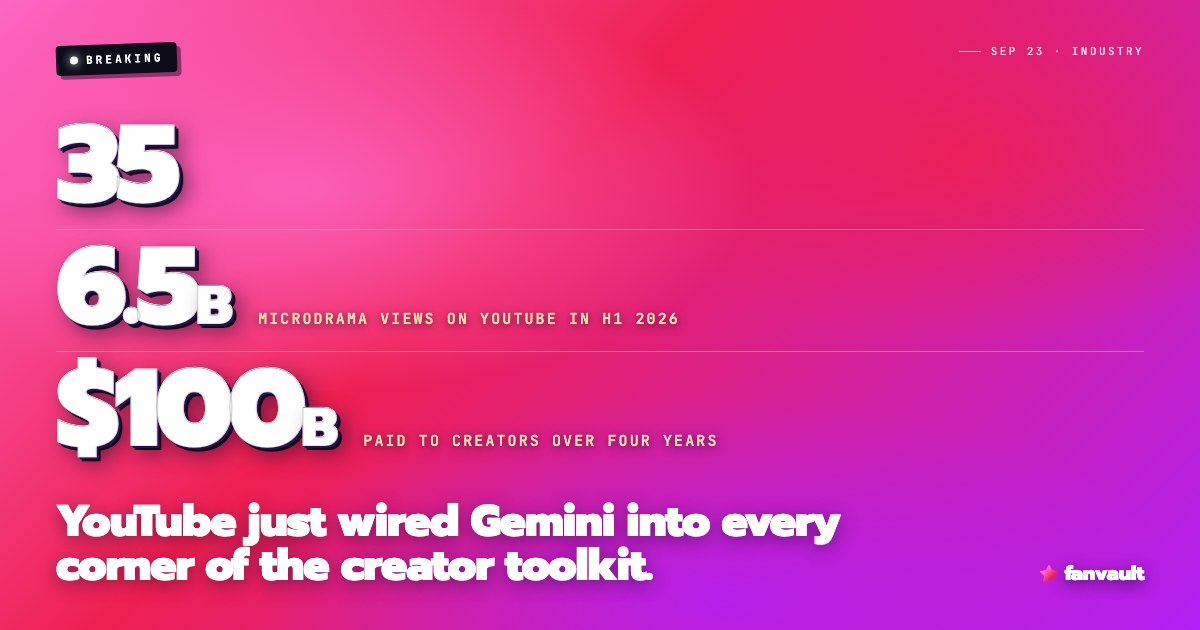
YouTube CEO Neal Mohan just used the Made on YouTube 2026 stage to wire Gemini into roughly every corner of the creator toolkit. In one hour on September 23, the platform unveiled about 35 product updates, from Gemini Omni conversational editing baked into Shorts to a background-running Studio AI agent. Plus a TV-style Shorts Series format with seasons and episodes, and Live auto-dubbing across 27 languages piloting in early 2027. Google just quietly declared it wants to run the whole creator workflow, editor to sponsor.
⚡ Key Takeaways
- YouTube shipped ~35 product updates in one hour at Made on YouTube 2026, all pointed at Gemini.
- Shorts Series turns vertical Shorts into TV-style seasons and episodes, riding 6.5B microdrama views in H1 2026.
- Gemini Omni is live inside Shorts and Create; a background Studio AI agent now handles packaging on its own.
- Creator Partnerships uses Gemini to match ~3M YPP creators with sponsors; BrandConnect is officially retired.
- Live auto-dubbing (27 languages) pilots in early 2027; likeness detection expands to mobile.
- Convenience trade: the same platform picks your thumbnails, dubs your stream, and now brokers your brand deal.
What actually happened?
Mohan took the New York City stage on September 23 and rattled off roughly 35 updates in a single hour, part of the over 3,000 shipped since January, per Tubefilter. Gemini Omni now lives inside Shorts and the YouTube Create app, and hundreds of thousands of channels used it per day in August 2026 alone. A new Ask Studio feature gives creators AI feedback on pacing, structure, and thumbnails. A background Studio AI agent quietly runs packaging and channel strategy without a prompt, closer to an assistant than a tool.
The headline creative launch is Shorts Series, a TV-style seasons-and-episodes format with custom thumbnails and sequential playback. It arrives as microdramas rack up 6.5 billion views on YouTube in the first half of 2026, per TechCrunch. TV-based microdrama viewing is up over 90% year over year, according to The Hollywood Reporter, even though the format is mobile-first. Connected TV now accounts for over 44% of U.S. YouTube watch time.
Why does this matter for creators?
Every tool a creator used to buy separately is getting absorbed into YouTube itself. Thumbnail testers, analytics dashboards, translation services, sponsorship marketplaces, brand-safety products, all now have a Gemini-powered equivalent one click deep in Studio. The pitch is obvious. Less friction, more time to shoot.
The cost is less obvious. Every one of those absorbed tools was a place a creator could carry leverage across platforms. When Studio drafts your thumbnail, dubs your live stream, and matches your brand deal, you are handing one company a much bigger say in what your channel actually becomes. That is convenience, and it is also concentration risk in a suit.
"YouTube Studio is evolving into an end-to-end creative partner to help across production, packaging, and channel strategy."
Neal Mohan, CEO, YouTube
Where does this go from here?
The money side of the keynote matched the tools side. YouTube has paid creators, artists, and media companies over $100 billion in the last four years, per CineD, and just locked in Coachella livestream rights through 2030, according to Variety. Creator Partnerships, the rebranded BrandConnect, now uses Gemini to scan the roughly 3 million YouTube Partner Program creators and match them with sponsors. Brand deals are getting picked by the same model that grades your thumbnails.
Live auto-dubbing extends the platform's 27-language auto-translation stack to real-time speech, piloting in early 2027, per TechCrunch. It targets the more than 40% of live watch time that comes from outside a creator's home country. Likeness detection is expanding to mobile too, so creators can flag AI impersonations from a phone. The through line: Google wants a Gemini fingerprint on every step of the workflow, from concept to comment section.
What does Fanvault think?
When one platform swallows the top of the funnel, the bottom of the funnel is where creator sovereignty actually lives. Fanvault runs the other side of that ledger. An 8% platform fee (creators keep 92%), a full storefront with authenticated memorabilia auctions and buy-it-now drops, and a Telegram-native automation layer that lets a creator schedule content and triage fan DMs from a chat window. Post the Shorts series on YouTube in the morning, monetize the audience on your own turf in the afternoon, without an ad-share cut skimmed in the middle.
Made on YouTube is a genuinely great argument for using YouTube. It is also a great argument for owning at least one revenue lane that YouTube doesn't get a percentage of, because a stack that unified is a stack that can decide, unilaterally, what your business looks like next year.
Gemini can draft your thumbnail. It can't own your storefront.
Frequently Asked Questions
What is Shorts Series and when does it roll out?
Shorts Series is a new format that lets creators structure Shorts into seasons and episodes with custom thumbnails and sequential playback, so vertical videos can be watched as continuous stories, especially on TV. YouTube announced it at Made on YouTube on September 23, 2026, and it started rolling out across web, mobile, and TV that same day, per TechCrunch.
Why is YouTube leaning so hard into microdramas?
Microdramas racked up over
What is Gemini Omni doing inside Shorts and Create?
Gemini Omni is the conversational Gemini variant baked into the Shorts editor and the YouTube Create app. It lets creators edit clips, generate elements, and refine posts through natural-language prompts instead of tapping through menus. As of August 2026, hundreds of thousands of channels use it per day, per the YouTube Official Blog.
What does Made on YouTube 2026 mean for smaller creators?
The upside is real: AI-assisted editing, thumbnails, translation, and brand matching used to cost money or hire hours, and now they ship inside Studio. The downside is that the same platform now decides what your Shorts series looks like, which language your live stream reaches, and which brand you get paired with. Small creators should keep at least one revenue lane (a storefront, a paid feed, a memorabilia drop) off the YouTube ad-share meter, so a single algorithm shift can't reset the whole business.
How does Creator Partnerships work now that BrandConnect is retired?
Creator Partnerships is the rebrand of BrandConnect, now powered by Gemini. It scans the roughly 3 million creators in the YouTube Partner Program to match them with brand deals based on channel content, audience, and past performance, per Brightbean. Advertisers no longer have to short-list creators by hand; the model does it and pipes offers to eligible channels inside Studio.