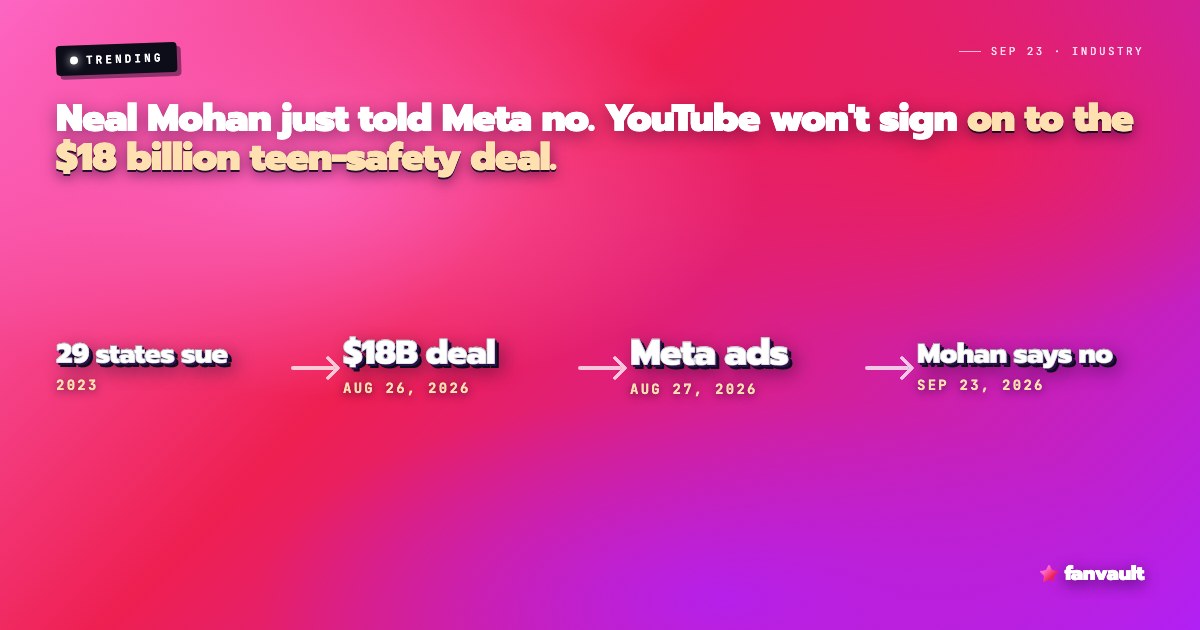
YouTube CEO Neal Mohan just said no to Meta's $18 billion teen-safety deal. At Made on YouTube on September 23, CNN Business asked whether YouTube would sign on to the terms Meta agreed with state attorneys general, and Mohan said the platform will stick with its own safety tools. That matters because Meta built the deal specifically to pull YouTube in. It also matters because YouTube is the platform three in four US teens use every day.
⚡ Key Takeaways
- YouTube CEO Neal Mohan told CNN that YouTube won't join Meta's $18 billion teen-safety settlement and will keep its own tools.
- Meta's deal gives teens a two-hour daily cap, pauses at 15, 60, and 90 minutes, a midnight-to-6am block, and hidden Like counts.
- Meta pays only 70% unless TikTok and YouTube each put up around $6 billion. The withheld 30% is roughly $5.3 billion.
- About 75% of US teens use YouTube daily, so a Meta-style cap would hit creator watch time, Shorts revenue, and brand-deal rates.
- States have said they will sue if YouTube and TikTok don't join. Teen reach is now regulated reach.
What actually happened?
On August 26, Meta agreed to pay up to about $18 billion to end claims that it designed Facebook and Instagram to addict young users, according to CNN Business. Up to $17.1 billion of that resolves the joint lawsuit 29 states filed in 2023, per the DC Attorney General's office. Meta admitted no wrongdoing.
The product terms matter more than the money. Users aged 13 to 17 get a combined two-hour daily limit, with mandatory pauses after 15 minutes of continuous use and again at 60 and 90 minutes, NPR reported. They also get an overnight block from midnight to 6am that only a parent can lift, according to PBS NewsHour. On top of that, autoplay is off by default, teens' Like counts are hidden, and an independent auditor can report to the attorneys general.
Then there's the catch. Meta will pay only 70% of the settlement unless TikTok and YouTube each agree to pay around $6 billion and adopt similar changes, CNN Business reported. Meta puts the withheld 30% at roughly $5.3 billion, according to Social Media Today.
| Teen protection | Meta settlement terms | YouTube today |
|---|---|---|
| Daily time limit | Two hours combined, pauses at 15, 60, 90 minutes | No platform-wide cap, parent-set Shorts limit |
| Overnight block | Midnight to 6am, parent-only unlock | None |
| Like counts | Hidden for teens | Public |
Mohan didn't budge. He pointed to the tools YouTube already has and to its work with third-party child-safety experts.
"We have invested in making sure that young people are safe on our platform… for a very long time."
Neal Mohan, CEO, YouTube, CNN Business
Why does this matter for creators?
Because YouTube is where teens actually are. Pew Research Center found about 75% of US teens use YouTube daily, and about one in five use it almost constantly. Roughly nine in ten have used it at some point.
If YouTube adopted Meta's terms, it would cut the watch time, Shorts views, and engagement signals behind AdSense, Shorts revenue share, and brand-deal rates for any channel with a young audience. YouTube already lets parents of supervised teens set a Shorts limit anywhere from two hours down to zero, CNN Business reported. But parents have to turn that on, so it isn't a hard cap. Mohan's no buys time. It doesn't settle anything.
If you run a gaming, fitness, or commentary channel that skews young, your teen audience is now the part of your business most exposed to legal risk. YouTube Studio won't show you that risk. Your RPM will, if a cap ever lands.
Where does this go from here?
Meta ran full-page newspaper ads calling its terms a "new industry standard" and saying the protections only work if TikTok and YouTube adopt them too, Calcalist reported. California Attorney General Rob Bonta has said the states are willing to take TikTok and YouTube to court if they don't join. TikTok still hasn't said whether it will.
"Meta intentionally exploited kids for profit and then lied about it, claiming its products were safe when its own internal research confirmed the platforms were addictive and harmful."
Brian Schwalb, Attorney General, District of Columbia
Fortune called the deal roughly a 1% tax on Meta and a play to box in TikTok and YouTube. That reading holds up. Meta took its own legal loss and turned it into a cost it can push onto its two biggest rivals for teen attention.
Schwalb's office put it plainly: Meta is the first platform to agree to these reforms, and "it will not be the last." Watch for state lawsuits against YouTube next.
What does Fanvault think?
Reaching teens is now regulated, and creators should plan for that. Fanvault is an 18+ platform: every user and creator is age-verified at onboarding and every creator is manually approved, so a fight over teen time limits doesn't touch revenue built there. Creators keep 92% (an 8% fee, versus 15% at Fanvue, 10% + $0.30 at Passes, and about 20% at Fanfix) across memberships, paywalled posts, paid DMs, tips, wishlists, and a storefront with auctions and authenticated memorabilia drops. Let YouTube and the attorneys general fight over teenagers' screen time, and build an adult audience with revenue you own now.
Mohan bought YouTube time, not immunity. Creators who count on a teen-heavy YouTube audience lasting are betting on a platform that is one lawsuit away from a curfew.
Frequently Asked Questions
Why won't YouTube join Meta's $18 billion settlement?
Neal Mohan told CNN Business that YouTube has invested in teen safety "for a very long time" and will keep focusing on its own tools. One example is a parental control that caps or blocks teen Shorts scrolling.
What did Meta agree to in the settlement?
Meta agreed to pay up to about
Why does Meta want YouTube and TikTok to sign on?
Meta will pay only 70% of the settlement unless TikTok and YouTube each agree to pay around $6 billion and adopt similar changes. Meta puts the withheld amount at roughly
How could this affect YouTube creators?
About 75% of US teens use YouTube daily, per Pew Research Center. If states sue and YouTube ends up with Meta-style limits, channels with young audiences could lose watch time, Shorts views, and the engagement signals that drive ad revenue and brand-deal rates.